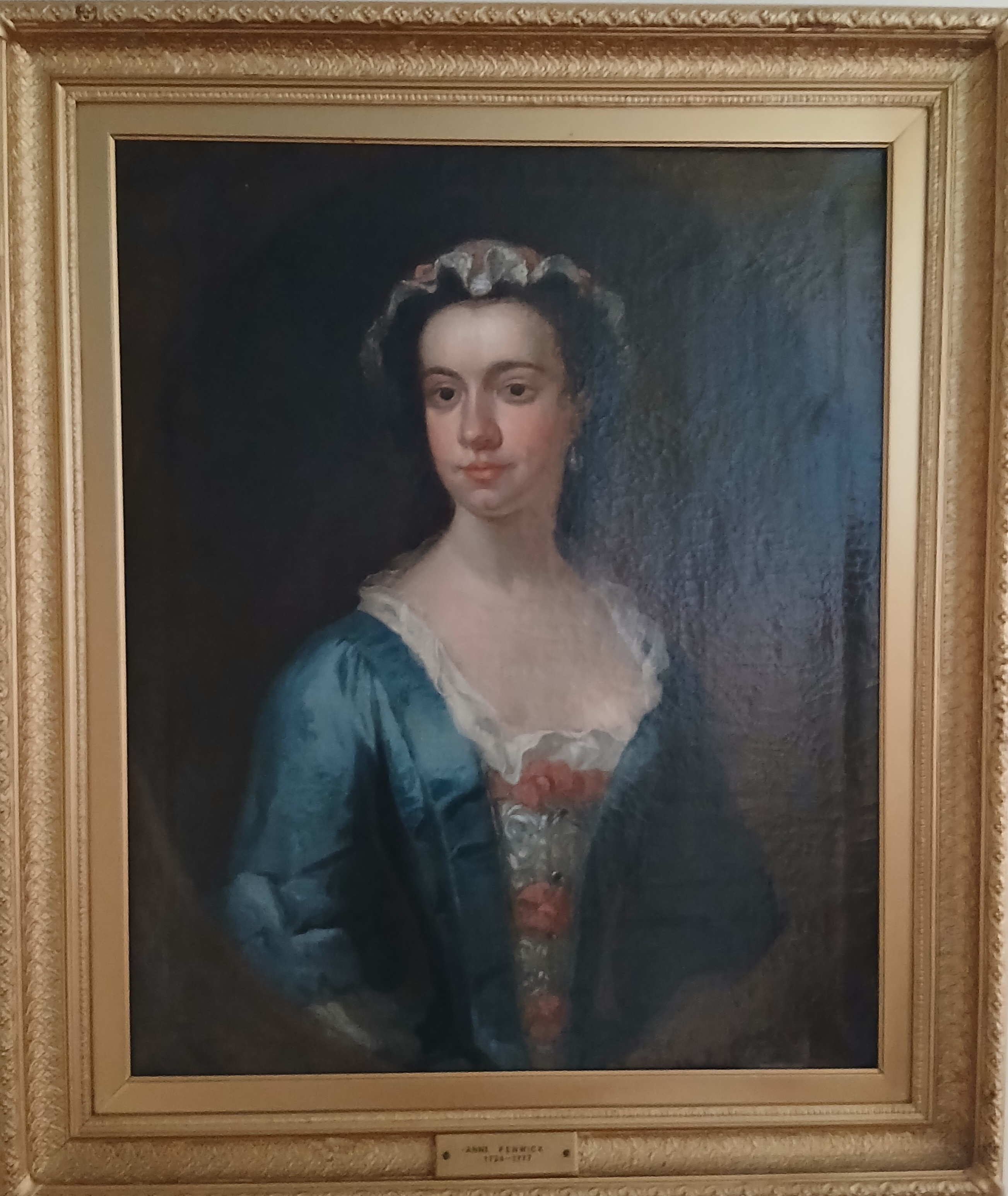
Ann Fenwick (1724 - 1777)
Ann Fenwick was born in 1724, the only child of an Anglican attorney of Lancaster, Thomas Benison, and his Catholic wife, Ann Dowbiggin. On the death of her father, when Ann was eleven, she inherited his estates, together with the newly-built Hornby Hall. From an uncle she inherited various mercantile interests and was owner of the ship 'The True Love'. Having completed her education (thought to have been at the Bar Convent, York), Ann settled with her mother at Hornby Hall and on coming of age took over management of her own affairs until, in 1752, she married John Fenwick of Burrow Hall, a local Protestant landowner. This 'marriage of true affection’1 came to a tragic end when John was killed in a hunting accident five years later.
As there were no children of the marriage and an act of Parliament banned Catholics from inheriting property, the whole of John's estates, which included the properties which Ann had brought to the marriage, were claimed by Thomas Fenwick, John's brother, a lawyer and member of Parliament. Thomas was persuaded by Ann's lawyers to make Ann an annuity and to permit her to live in Hornby Hall, and a document to this effect was drawn up. He failed to honour the agreement, however, and though some quite large payments were made, as seen from Ann's meticulous accounts, at times her affairs were at such a low ebb that she was unable to pay her servants. Her beloved mother died in 1762, never knowing of her daughter's difficulties, nor did Ann confide her troubles to any but her lawyers, for she did not wish to cause distress to her late husband's family.
After her mother's death, and in poor health, Ann travelled to Bath in order to take the waters, and records that she ‘had the honour to drink her glass with Mr Pitt at the Pump Room.’2 That same year Ann's long-desired wish was fulfilled and she was able to install Thomas Butler to serve as chaplain to her household and to the Catholics of the district.
In 1769 Ann, now declared bankrupt, was at last persuaded by her lawyers to seek redress through the courts of law. In 1770 an action was procured, before the King's Bench, to impel Thomas Fenwick to uphold the terms of the settlement and to pay his debts to her. This was to be done by the sale of some of his properties, but Thomas again invoked the act of 1701, and his claim was upheld. The case became a cause célèbre amid general indignation.
Ann now determined to take matters into her own hands and, on the advice of Lord Hardwick, she travelled to London to seek an interview with the Lord Chancellor, Lord Camden. Much struck by the injustice of her predicament, but unable to take the matter further through the courts, he brought a Private Bill before the House of Lords. There the injustice of the matter was unanimously deplored, and in 1772 an Act was passed which awarded Ann nearly £7000 and an annuity of £400 until her death.
Ann returned to her home at Hornby Hall where in spite of increasing ill health she continued to devote herself to her many charitable works, with a special care for children. She died in 1777 aged 53 and was buried with her parents in St Wilfrid's Church, Melling, in the main aisle before the chancel. Bishop Foley described her as 'an indomitable woman whose courageous fight for her inheritance, which as a papist she had forfeited, brought to light some of the disabilities under which Catholics were living and so helped to create a climate for toleration.’3 In 1778 the First Catholic Relief Act was passed.
In her will Ann made provision for the continuance of spiritual care for the Catholics of Lunesdale, bequeathing to Thomas Butler the funds which allowed him to procure land next to Hornby Hall where, in 1779, he built the house/chapel which now serves as St Mary's presbytery.